Playwright certifications have started popping up across online platforms - promising credibility, skills validation, and better QA career opportunities. But the real question is whether a certification helps you build better test automation or just adds another badge. Here’s what’s actually worth your time in 2025, what’s just marketing, and how to evaluate certifications strategically.
Why certifications became popular again
A few years ago, automation engineers didn’t need certifications, they needed working tests. But with Playwright becoming a standard for web testing and more companies integrating automation earlier in CI/CD, structured learning has become attractive again.
Certifications now serve three main purposes:
- Skill validation for hiring or freelance portfolios.
- Structured learning paths for new QA engineers.
- Community recognition in competitive markets.
The question is no longer “should I learn Playwright?” - it’s “how should I prove I actually know what I’m doing?”
The current landscape of Playwright certifications
In 2025, there’s no single “official” Playwright certification issued by Microsoft. Instead, you’ll find independent or partner-led programs built around the framework.
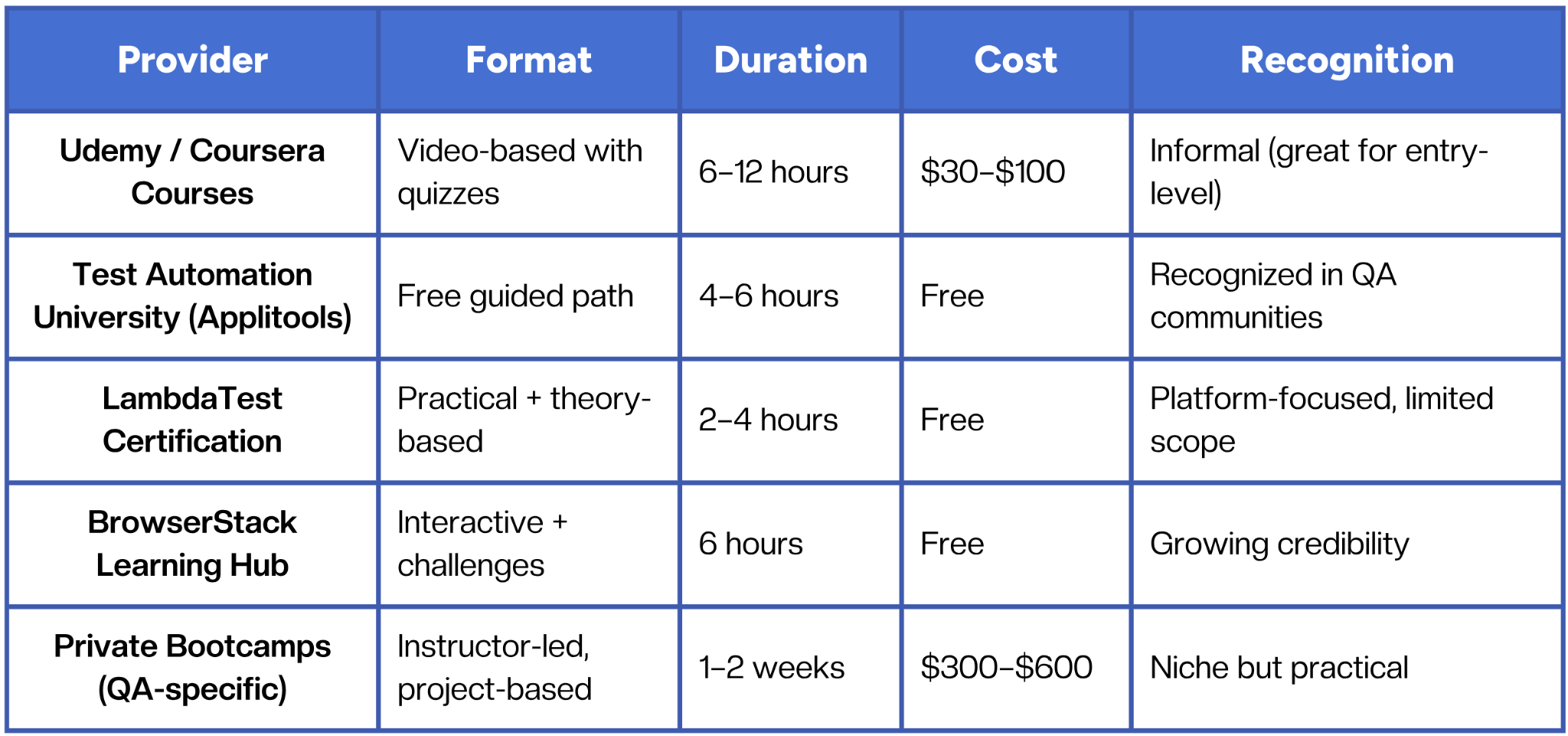
None of these certificates guarantee mastery - they mostly indicate exposure to the ecosystem and understanding of key concepts.
What certifications can (and can’t) do
What they do well:
- Give structure to your learning process.
- Help new engineers bridge the gap between manual QA and automation.
- Provide vocabulary and patterns recognized in interviews.
- Offer guided exposure to CI/CD, test architecture, and debugging workflows.
What they don’t do:
- Replace hands-on experience.
- Teach scaling test frameworks in production.
- Cover hybrid automation (AI-generated or self-healing tests).
- Reflect your ability to debug flaky builds or manage infrastructure.
In short - certifications are a starting point, not an endpoint.
What to look for in a quality Playwright certification
When choosing a program, focus on content depth and context.
Ask yourself:
- Does it include real project scenarios, not just syntax?
- Does it explain CI/CD integration (GitHub Actions, Jenkins, etc.)?
- Does it address test data, parallelization, and flakiness?
- Are there hands-on challenges or live coding tasks?
- Is the instructor or organization connected to the Playwright ecosystem?
If the certification can’t help you write, debug, and scale Playwright tests confidently, it’s probably not worth the time.
Certification vs. practical experience
While certifications show initiative, practical experience still matters more, especially in automation-driven QA teams.
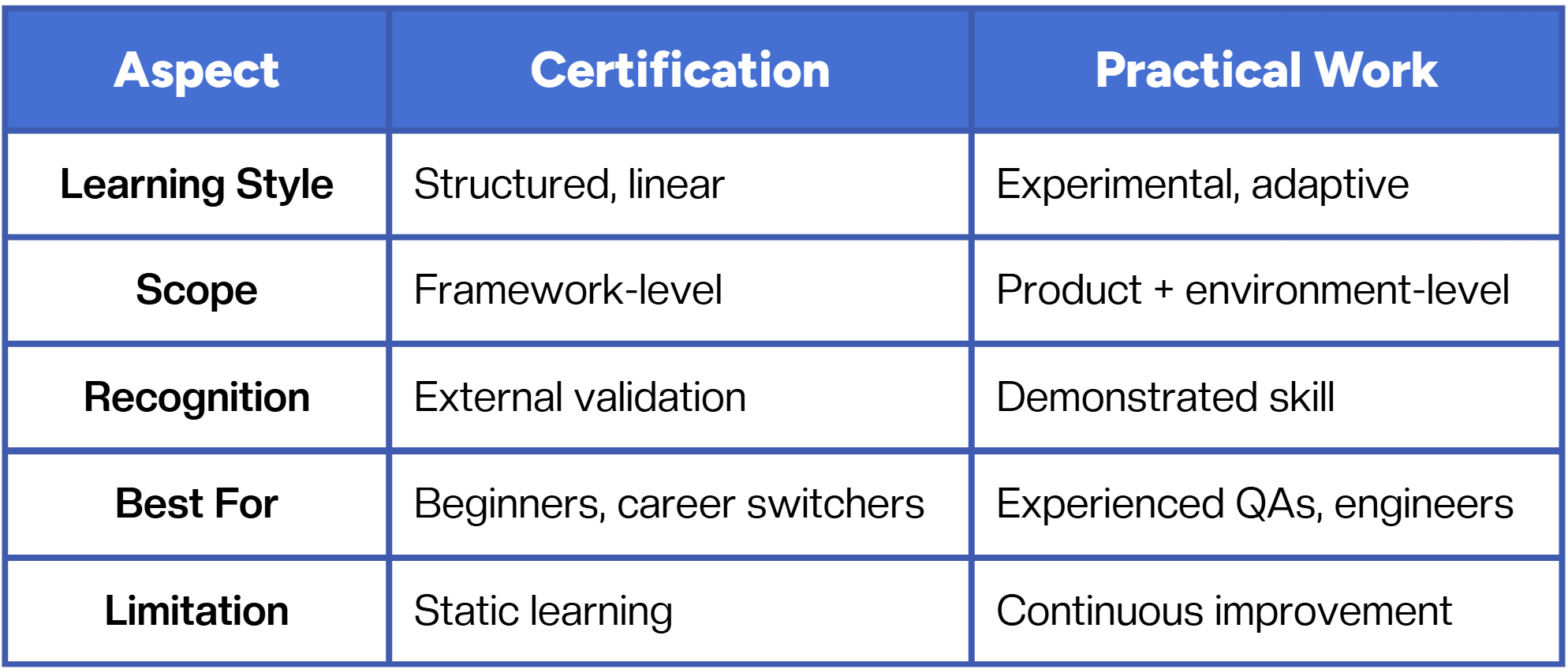
A good balance is to use certifications to build the foundation, then apply those skills in real-world pipelines, CI setups, and code reviews.
How certification fits into modern QA workflows
Automation isn’t static anymore. Teams increasingly combine Playwright with:
- AI-assisted test generation
- Self-healing selectors
- Dynamic test grouping based on code changes
- Continuous validation pipelines
Learning Playwright in isolation misses how testing fits into the larger product delivery cycle. A strong certification (or learning path) should show how to:
- Integrate with Git-based workflows.
- Optimize for performance in CI.
- Use API + UI testing together.
- Design maintainable test architectures, not just pass exams.
When certification makes sense
A certification can be genuinely useful if:
- You’re new to automation and need structure.
- You’re applying for QA roles where Playwright is required.
- Your company uses certification as part of its internal training or hiring process.
- You want to transition from Selenium or Cypress to modern frameworks.
But if you’re already managing test pipelines, reviewing automation PRs, or designing CI/CD flows, your portfolio is your certification.
A realistic roadmap for mastering Playwright (with or without a certificate)
- Learn the basics – selectors, actions, assertions, waits.
- Build sample tests – create modular, reusable test functions.
- Run them in CI – automate with GitHub Actions or GitLab CI.
- Add visual & mobile tests – emulate devices and track regressions.
- Experiment with AI tools – explore self-healing or auto-generated test flows.
- Contribute to projects – open-source repos, internal QA frameworks, or documentation.
Certification can validate steps 1–3, but steps 4–6 are what make you stand out as an automation engineer.
Conclusion
Playwright certifications are becoming more common, but their real value depends on how you use them. For most engineers, they’re a structured entry point into automation, not a career shortcut. What truly builds credibility is your ability to design reliable tests, interpret failures, and integrate automation seamlessly into development workflows.
Certification proves you’ve studied the framework. Experience proves you understand it.
Fast and reliable test automation


.png)