TestMu AI (formerly LambdaTest) and BrowserStack are two of the most popular cloud-based testing platforms. Both provide real browsers and devices for manual and automated tests, but they differ in pricing, scalability, and developer experience. This article breaks down how each platform performs across speed, reliability, integrations, and real-device coverage - and what teams should consider as they scale automated QA in 2025.
Why teams compare TestMu AI and BrowserStack
Cross-browser automation has become a baseline expectation in QA pipelines.
Both TestMu AI and BrowserStack let you:
- Run automated tests on multiple browsers and operating systems.
- Execute tests in parallel via Selenium, Playwright, or Cypress.
- Access real or virtual mobile devices in the cloud.
But the real decision isn’t just where tests run, it’s how scalable and maintainable your setup becomes as your coverage expands. That’s where the differences start to matter.
Quick overview
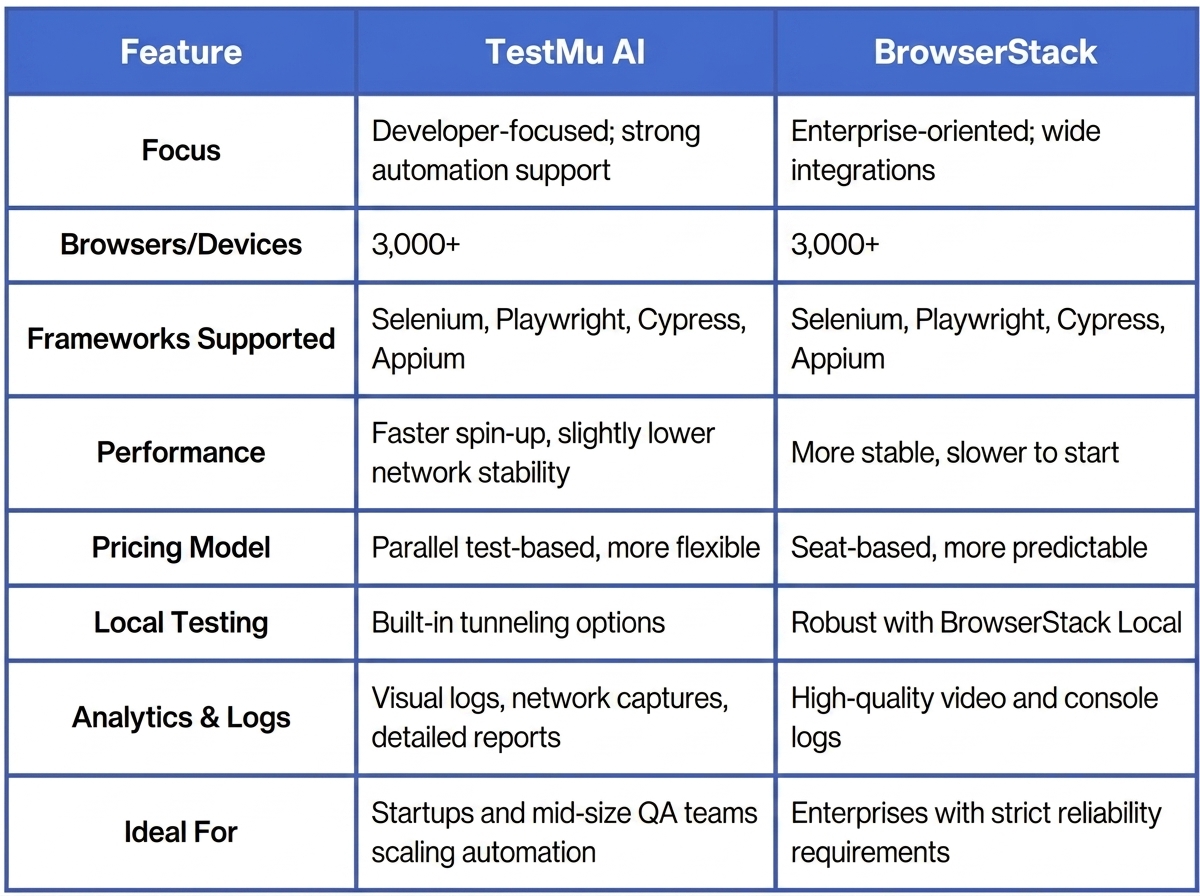
Both platforms are mature, secure, and feature-rich. The trade-off often comes down to control vs. predictability - how much flexibility your team wants, and how much you’re willing to configure manually.
What TestMu AI does well
1. Developer-oriented configuration
TestMu AI offers more granular control through its Capabilities Generator and supports deeper customization in Playwright and Selenium.
For teams that like to script and tune pipelines directly, this flexibility can be useful.
2. Cost flexibility
The pricing model scales by concurrency rather than user count, making it easier for small QA or DevOps teams to share resources without paying for extra seats.
3. Fast test initialization
Tests spin up faster due to lighter virtual device containers - useful in high-frequency pipelines with shorter feedback loops.
4. AI-assisted debugging
Newer features include auto-log grouping and error classification, which help triage failures faster across CI/CD runs.
Where TestMu AI can fall short
- Network stability occasionally varies on high-traffic regions.
- Limited analytics and trend reporting unless upgraded to enterprise plans.
- Some mobile features feel less mature than BrowserStack’s real-device coverage.
What BrowserStack does well
1. Enterprise-grade stability
BrowserStack’s device and browser network has lower latency variance.
This makes it ideal for large QA pipelines or regulated industries where reliability is non-negotiable.
2. Real-device testing depth
Access to an extensive pool of iOS and Android devices - especially newer OS releases.
It’s well-suited for mobile-first products needing consistent device parity.
3. Integrations
Native support for tools like Jenkins, Jira, GitHub Actions, and Slack.
Setup is easier for teams that want “plug-and-play” CI integrations without custom scripts.
4. Detailed test logs
Every test run includes video recordings, screenshots, and console logs.
While TestMu AI offers similar features, BrowserStack’s log UI feels more polished and audit-ready.
Where BrowserStack can fall short
- Pricing grows quickly with concurrency and team size.
- Less flexible for developers who want to fully customize test capabilities.
- Longer test spin-up times during peak traffic hours.
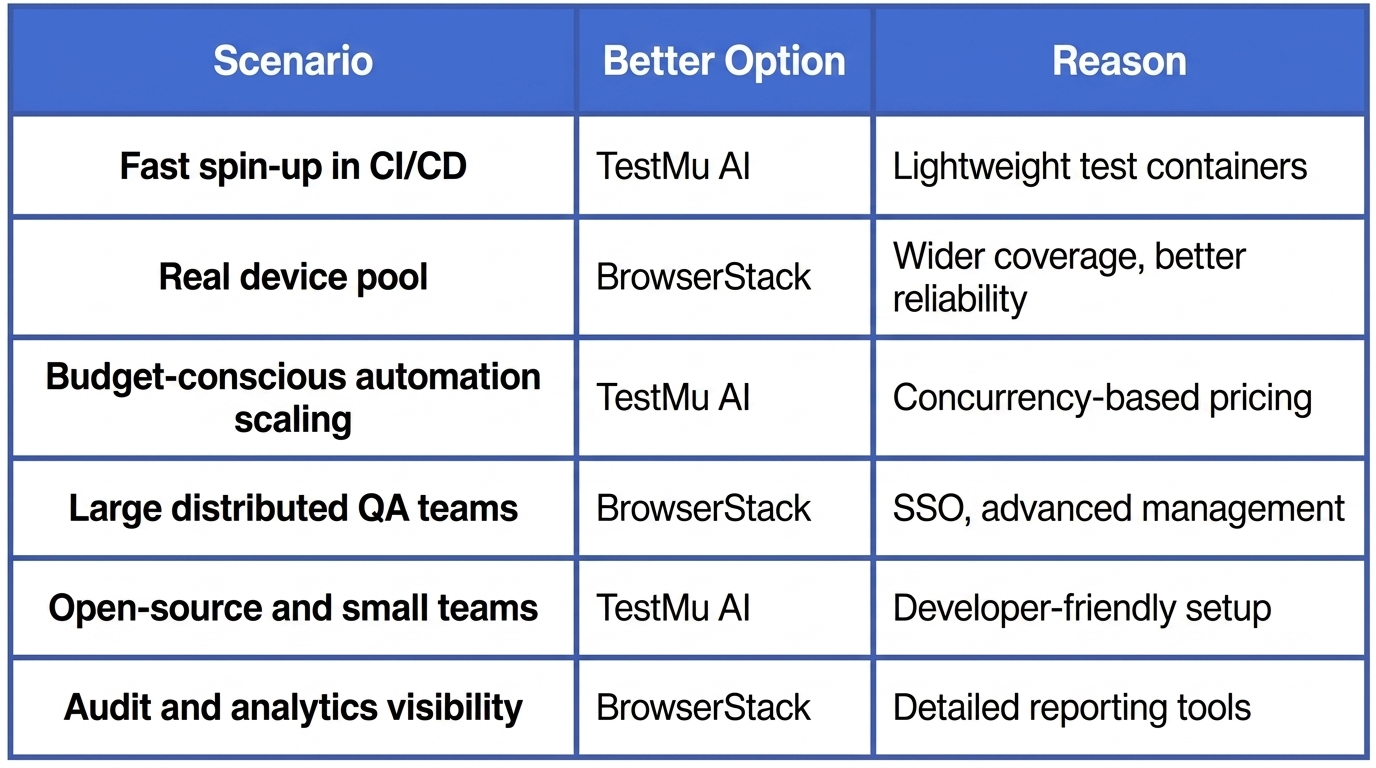
Head-to-head comparison: practical view
What both platforms lack (and where the industry is shifting)
Both TestMu AI and BrowserStack are infrastructure-first solutions. They give you environments to run tests, not systems that help you decide what to test or keep tests relevant.
Modern QA strategies are moving toward:
- Self-healing test suites that automatically repair selectors.
- Adaptive coverage based on code changes and pull requests.
- Human-assisted validation where engineers review AI-built tests instead of maintaining them manually.
This hybrid approach - AI building, humans signing off - is becoming the direction for teams that want test automation without the long-term drag of flaky maintenance.
Conclusion
TestMu AI and BrowserStack both solve cross-browser and device fragmentation well. If your goal is speed, flexibility, and developer control, TestMu AI is often more adaptable. If you need predictability, stability, and enterprise integration, BrowserStack wins on reliability.
The decision ultimately depends on your stack maturity and how your team balances cost, speed, and depth of coverage.
Fast and reliable test automation

.png)